

Titanium alloys are widely used in the aerospace field due to their high strength and good corrosion resistance. This paper introduces the microstructure and mechanical properties characteristics of major titanium alloys in recent years, including high-strength and high-toughness titanium alloys (β-type or sub-stable β-type, Ti-1023, Ti-15-3, β21S and BT-22), high-temperature titanium alloys (above 500°C, near-α-type, IMI834, Ti-1100, BT36 and Ti-60), damage-tolerant titanium alloys (α+β-type TC21 and TC4-DT) and flame retardant titanium alloys (Alloy C, BTT-l and BTT-3) in four areas.
According to the effect on β-transformation temperature, the alloying elements of titanium can be divided into neutral elements, α-phase stable elements and β-phase stable elements. α-phase stable elements extend the α-phase region to a higher temperature range, while β-phase stable elements move the β-phase region to a lower temperature, and neutral elements have little effect on β-transformation temperature.
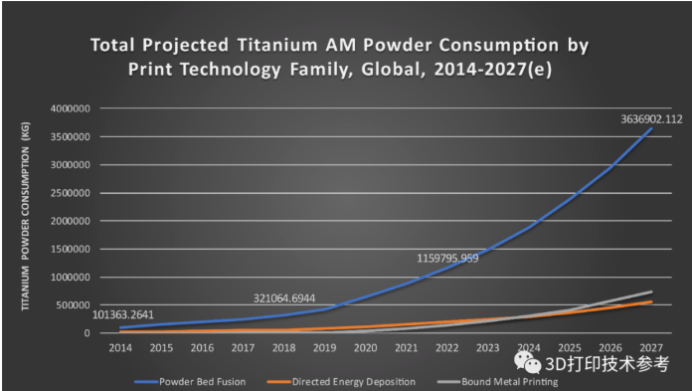
Total Titanium 3D Printing Powder Consumption Forecast 2014-2027
(Source: SmarTech)
Al is the most important α-phase stabilizing element, and the interstitial elements O, N and C also belong to this category. β-phase stabilizing elements can be subdivided into two categories: β-homocrystalline and β-eutectic elements, Mo, V and Ta belong to β-homocrystalline elements, which are highly soluble and very important in β-titanium; Fe, Mn, Cr, Co, Ni, Cu and Si belong to eutectic elements, which are easy to form intermetallic compounds with Ti; Sn and Zr are neutral elements, but can significantly strengthen the α phase.
With the development of titanium alloy research and application, especially heat treatment strengthened titanium alloys, non-equilibrium state organization is often encountered, so it is more desirable to classify titanium alloys according to the phase composition of sub-stable state. According to the phase composition of titanium alloys after quenching from the β-phase region in relation to the β-stable element content, titanium alloys can be classified into several types such as α-type, near-α-type, α+β-type, sub-stable β-type, and stable β-type.
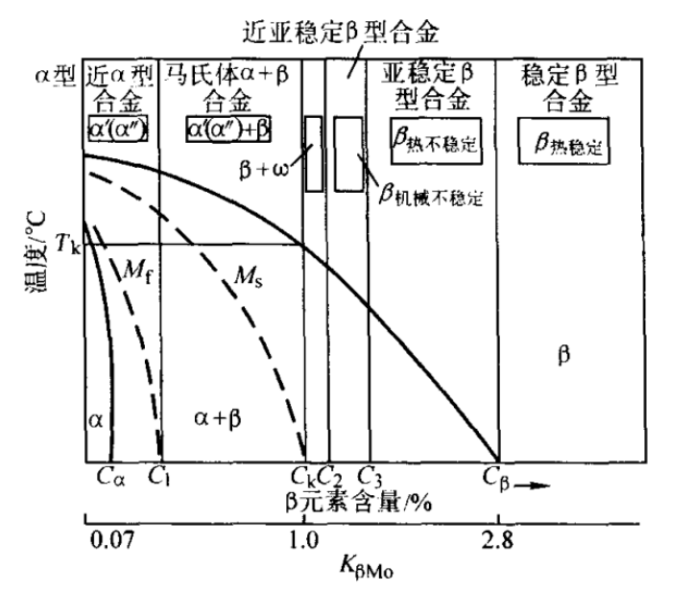
Phase composition of titanium alloys after quenching in relation to β-stable element content
The main properties of various titanium alloys, with Ti-6Al-4V prevailing, to the right, with the increase of β-stabilizing elements, the alloy's processability, strain rate sensitivity, heat treatment strengthening effect and room temperature strength are increasing; to the left, with the decrease of β-stabilizing elements, the alloy's β-transition temperature, flow stress, weldability and high temperature strength are increasing. Table 1 lists the main chemical composition, grades and main mechanical properties of commonly used titanium alloys.
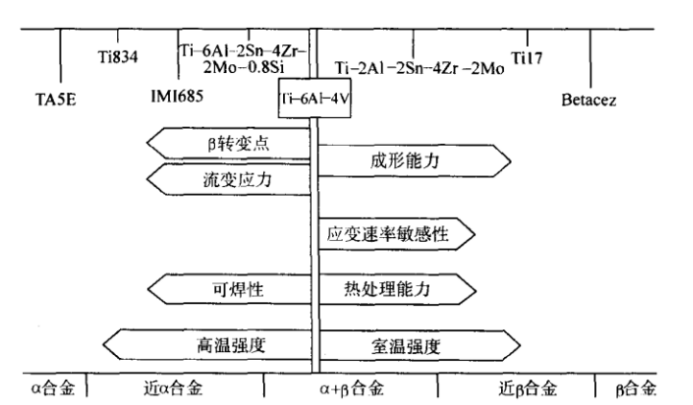
The main performance characteristics of each type of titanium alloy
The conventional microstructure of titanium alloys is described by the dimensions of the two basic phases, α and β phases (i.e. α solid solution based on α titanium and β solid solution based on β titanium) and their arrangement. The properties of titanium alloys depend mainly on the arrangement of the α and β phases, their volume fractions and their respective properties. Compared with the body-centered cubic β-phase, the densely arranged hexagonal α-phase has a higher packing density and anisotropic lattice configuration, which results in poorer plasticity, lower diffusion rate and higher creep resistance of the α-phase. Therefore, the main differences in physical, mechanical and technological properties of different types of titanium alloys are shown in the following table.
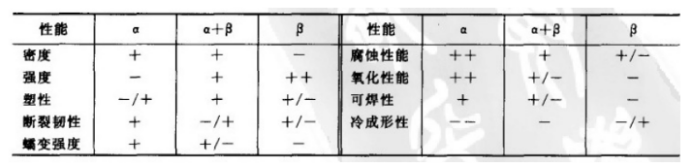
The relationship between different titanium alloy types and the main physical and chemical properties
Note: О means no effect; + means improved performance; - means reduced performance
Alpha titanium alloys are generally single-phase alloys with moderate strength, while alpha+beta two-phase and sub-stable beta titanium alloys can be strengthened to higher and very high strength levels, respectively. Sub-stable β titanium alloys achieve very high strength at the cost of low plasticity, and without age strengthening, sub-stable β alloys have relatively good plasticity similar to α and α+β.
Since the fracture toughness of titanium alloys is closely related to microstructure and aging conditions, there is no clear relationship between composition and fracture toughness of titanium alloys, but the fracture toughness of coarse lamellar tissue is higher than that of fine isometric tissue. This is because the lamellar organization can deflect the extended crack along the differently oriented slat bundles, leading to passivation of the crack front and thus absorbing additional crack extension energy.
The relatively low atomic diffusion capacity and deformation capacity of densely packed hexagonal crystals lead to excellent creep resistance of the alpha phase. The high affinity of titanium for oxygen atoms means that a very thin dense oxide layer (TiO2) can also form on the surface of titanium alloys in room temperature atmospheres, which accounts for the excellent corrosion resistance of titanium alloys. α titanium alloys have extremely limited deformability and high work hardening capacity, which means that α and α+β alloys can only be machined at high temperatures.