

With the development of 3D printing technology, it has gradually integrated into our life, 3D printed food, 3D printed toys, 3D printed cars, 3D printed cookies, even 3D printed houses and other 3D printed various products.
3D printing involves a wide range of fields including education, medical, manufacturing, aerospace, military, etc. The reason why 3D printing is so powerful relies on a variety of technical routes, that is, a variety of printing methods. In this article, we will briefly introduce to you the principles of FDM 3D printing and several factors that affect the accuracy of FDM molding!
Fused deposition manufacturing 3D printer (FDM) is the solid plastic wire material heated and melted through the nozzle squeeze out, on the workbench stacked into a certain shape, the liquid material after heat curing has a certain strength, this is the principle of printing. The principle diagram is shown below: 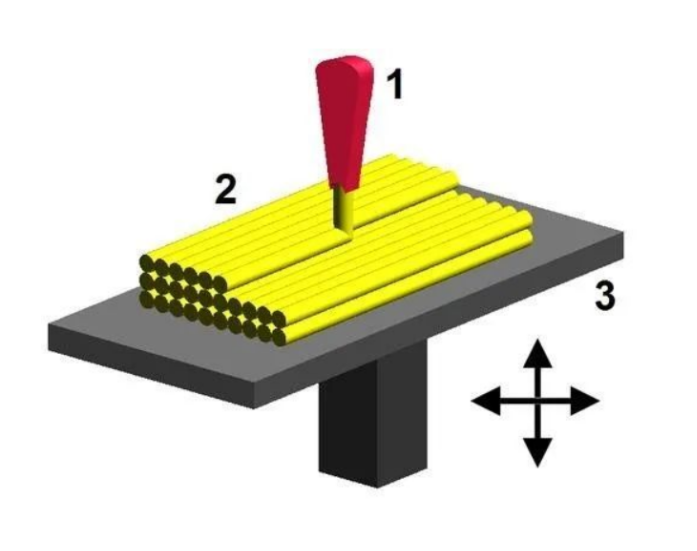
FDM molding accuracy includes dimensional error, geometric error and surface roughness. The factors that affect these three in the 3D printing molding process are as follows:
1.Material shrinkage. The material undergoes 2 phase changes of solid-liquid-solid during the FDM process. When the material solidifies and forms, the stress strain caused by the material shrinkage will affect the accuracy of the formed part. If the material in the forming process is determined, this error can be eliminated by setting the "shrinkage compensation factor" in the current data processing software in the x, y, z 3 directions for dimensional compensation.
2, nozzle temperature and forming chamber temperature. Nozzle temperature determines the bonding properties of the material, stacking properties, silk flow and extrusion width, neither too low, so that the viscosity of the material increases, the extrusion speed becomes slower, nor too high, so that the material is biased toward the liquid state, the viscosity coefficient becomes smaller, strong mobility, extrusion is too fast to form a precisely controlled silk.
The setting of the nozzle temperature should be selected within a certain range according to the nature of the filament material to ensure that the extruded filament is in a molten flow state. The temperature of the forming chamber will affect the size of the thermal stress of the formed part. A high temperature will help reduce the thermal stress, but the surface of the part will be easily wrinkled; while a low temperature will increase the thermal stress of the formed part by the sudden cooling of the extruded filament from the nozzle, which will cause warping and deformation of the part. Experiments have shown that in order to form smoothly, the temperature of the forming chamber should be set at 1 ℃ to 2 ℃ lower than the temperature of the extruded wire. General forming room temperature is set at 55 ℃.
3.Layer thickness. It refers to the thickness of the cross section of each layer of slices during the forming process. As each layer has a certain thickness, it will produce the phenomenon of steps on the surface of the formed entity, which will directly affect the dimensional error and surface roughness of the formed entity. For FDM process, this is a principle error, to completely eliminate the step is impossible, only possible to reduce the step effect by setting a smaller layer thickness.
4.Compensation amount. It is the value of the distance between the actual processing contour line of the part and the ideal contour line, the setting of the value is related to the diameter of the extrusion wire, which can be set directly in the layered slicing data processing software.
5, extrusion speed and filling speed and their interaction. Within a reasonable matching range with the filling speed, as the extrusion speed increases, the cross-sectional width of the extruded wire gradually increases, when the extrusion speed increases to a certain value extruded wire adheres to the outer cone of the nozzle, it can not be processed normally filling speed than the extrusion speed, the material is underfilled, the phenomenon of broken wire, it is difficult to form. On the contrary, the filling speed is slower than the extrusion speed, the molten wire piled up on the nozzle, so that the forming surface material distribution is not uniform, the surface will have lumps, affecting the quality of molding. Therefore, the filling speed and extrusion speed should be matched within a reasonable range.
6.Forming time. The forming time of each layer is related to the filling speed the size of the layer's area and the complexity of the shape. If the layer area is small, the shape is simple, filling speed is fast, the layer forming time is short on the contrary, the time is long. In processing, control the forming time of each layer in order to obtain a high precision forming parts.
7.Open and close delay time. That is, the start-stop effect of the filament stacking, mainly by the changes in the filament stacking cross-section is reflected, the inconsistency of this stacking cross-section is easy to cause the filament stacking plane uneven appearance of quality defects such as cavities. The "pulling" phenomenon affects the surface smoothness of the prototype and the flatness of the filament stacking surface within the filled layer. The fundamental solution to this problem requires that the filament speed be coupled to track the scanning speed in real time, and that the corresponding adjustment be made for the change in scanning speed to make the filament stacking smooth and reliable and to improve the quality of the filament stacking.