

What is carbon fiber
Carbon fiber itself is extremely tensile, thin and brittle, so it is not suitable for practical use alone, but when the fibers are bonded together in groups with a binder, carbon fiber forms a composite material with good performance and light weight, and the more common applications of carbon fiber materials are in the aerospace and automotive industries. This high strength, high stiffness and light weight make it a great alternative to heavier metal parts.
Carbon fiber material is also divided into short-cut carbon fiber and filament carbon fiber, for example, 3d printing well-known brand stratasys company in the Fortus 380mc carbon fiber 3d printer, it is used Stratasys FDM nylon 12 carbon fiber, nylon 12 carbon fiber (12CF) is a PA12 (polyamide 12) thermoplastic filament, reinforced with carbon fiber shreds, 35% of the weight, belongs to the short-cut carbon fiber, because in all FDM thermoplastics, bending strength is the largest, and therefore has the highest stiffness to weight ratio.
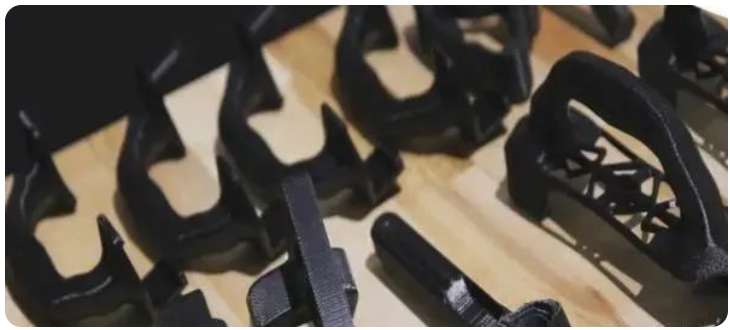
Carbon fiber 3d printer scope of application and advantages
Carbon fiber 3d printing can be used for functional prototypes, industrial tools and many other fields. In 3d printing for functional prototypes, carbon fiber 3d can print functional brackets to optimize geometry and reduce weight and cost; in 3d printing for industrial tools, carbon fiber 3d can print sheet metal forming tools with a compressive strength of more than 900, and can also print automotive leaf spring U-bolt assembly fixtures to replace Metal tools, drilling guides with metal inserts, CNC fixtures, FDM inspection fixtures (such as CNC molds and nondestructive testers), etc. This not only simplifies the production process, but also reduces the cost of traditional machining production, improves its processing and production speed, and promotes efficient production of enterprises.
In the case of a leading commercial product manufacturer, for example, the carbon fiber ABS-CF10 material was used to print handle prototypes, breaking the limitations of traditional prototyping that required the development of cast molds. The material cost for printing 10 different handle prototypes using carbon fiber ABS-CF10 material was only $200, a 98% savings from 3D printing compared to the $12,500 cost of a cast mold. 85-95% of the time. Although up to 5,000 handles can be produced with the cast mold approach, there is only one handle configuration. If you want to change the design, you need additional tooling. Using 3D printing, however, multiple designs can be achieved at a very low cost.