

The automotive industry is constantly evolving and needs to incorporate new technologies, and the vehicle production process involves highly complex production processes that face the dual challenges of both traditional and new technologies competitively, while having relatively high access standards. According to the Wohlers 2020 report, the automotive industry has become the largest market for 3D printing technology applications, surpassing aerospace and medical fields.
Tesla, BMW, Mercedes-Benz, Volkswagen and other automakers have introduced additive manufacturing technology. 2020 April, foreign engineer Sandy Munro disassembled the Tesla Model Y, in which 3D printed parts were used in the car's HVAC system. This also means that 3D printing technology does not stay in the "process verification", but has been directly used in automotive manufacturing.
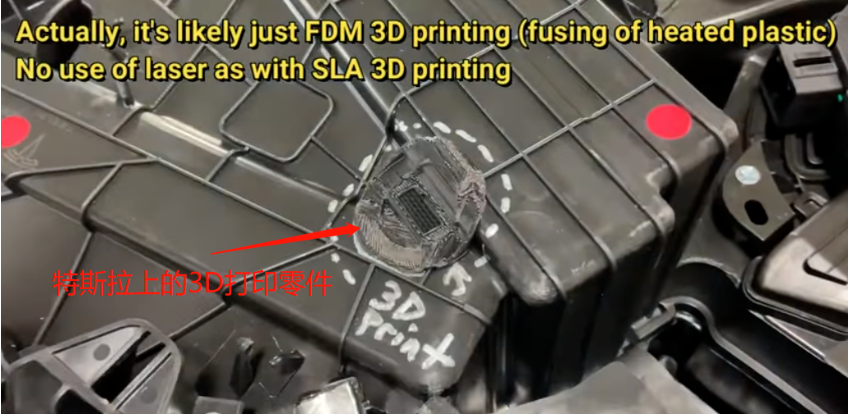
3D printed parts on the Tesla Model Y, manufactured using the FDM process
Three high performance production materials
1. XPET™: Controlled dispersion and distribution of reinforcing glass fibers in the material matrix during the extrusion process, resulting in a mesh skeleton structure within the material and carrying most of the load transferred by the material matrix. Smart fiber reinforcement technology greatly improves the mechanical properties and heat resistance of the material, and releases the internal pressure during the printing process by reinforcing the fiber mesh structure, resulting in printed parts with good dimensional stability and no warpage problems.
2. XPA™: is a glass fiber reinforced nylon (PA6) with excellent mechanical properties (impact strength and stiffness). The material has excellent thermal and mechanical properties while preserving adhesion between printed layers. XPA™ can work over a wide temperature range to produce parts and has been used by a customer to produce laboratory equipment at temperatures as low as -190°C.
3. PA12CF : It has superb wear resistance, low coefficient of friction, self-lubrication and excellent wear resistance. Easy to achieve all kinds of high-strength gears or high wear-resistant requirements of industrial applications. Ultra-low moisture sensitivity PA12CF base material using PA12 long chain nylon, saturated moisture absorption rate is only one tenth of the ordinary PA6, completely solve the nylon material moisture absorption before and after the mechanical properties and dimensional stability of the defects of great changes.

The use of additive manufacturing technology to produce automotive parts can not only meet the customized needs of customers, but also simplify the production process, save costs and improve production efficiency, which is a significant advantage compared with traditional manufacturing processes.