

3D printing has come a long way in the last five years. 3D printers are readily available to businesses, it is fairly priced, and knowledge of the technology within businesses is increasing. The manufacturing technology itself has become widely recognized and regularly makes industry headlines.
The first 3D-printed house went on sale this year. 3D printing extends beyond a wide range of consumer products; it can be applied to a much wider range of applications, from renewable energy to healthcare. In short, additive manufacturing (AM) offers us an alternative way to make things. However, what people don't realize is that the advantages of 3D printing are already being revealed, such as its ability to reduce the cost of production lines by optimizing tools.
Save money with a little
We can't deny the tremendous value that can be gained from the use of additive manufacturing technologies for end-use component applications. We are able to see that these products often undergo massive development, requiring huge costs and long turnaround times. However, with additive manufacturing, manufacturers don't need to make big plans or fundamentally change their final products - they can simply improve the way they produce them - and they can increase production. In fact, manufacturers can get a quick win by introducing additive manufacturing into their existing manufacturing processes.
For people working on complex traditional production lines, this may come as a surprise because it will make things easier for them. Production lines often include tens of thousands of grippers, brackets and other parts, and additive manufacturing can support each one of them. Additive manufacturing does not need or want to replace traditional manufacturing. However, it does impact traditional production lines - whether injection molding, complex assembly lines, or bottling plants - because of the savings it offers for production costs. Not only that, but its superiority goes far beyond cost savings.
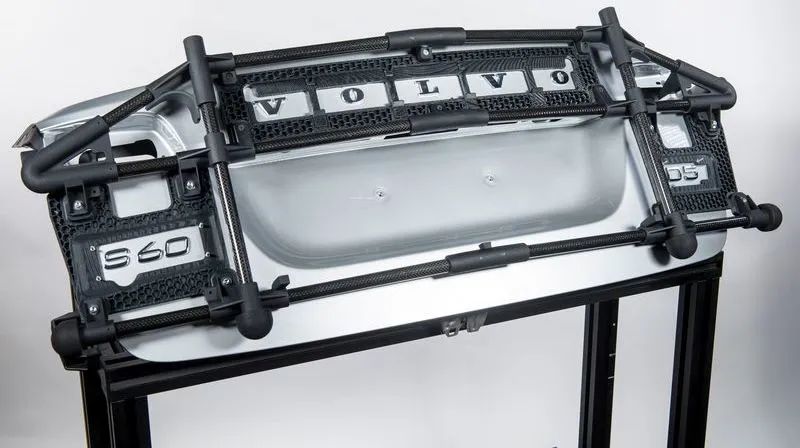
Volvo halves cost of production fixtures
Take Volvo's Ghent plant, for example. Half of Volvo's annual car production takes place at this plant, which produces approximately 57 cars per hour. Speed is critical, but precision cannot be ignored. This is made even more challenging given that three different series - with different models in each series - are all produced on the same line.
Each car needed to have a specific brand mark, model number, and a number of other markings. This requires that each badge be placed in the same location without damaging the paintwork. Previously, this was done with a variety of cumbersome gluing jigs - heavy, delicate and expensive, and very tedious. In addition, if a part broke, there was a six-week wait to get a new one.
This cumbersome production line tooling is often the best option for demonstrating additive manufacturing technology. The key when using additive manufacturing fixtures is this: just as not all parts of an end product need to be 3D printed, not all parts of a manufacturing tool need to be 3D printed, but if they can be combined they can reduce costs.
The Materialise Maris team researched the fixture and realized that it could be manufactured from a mix of off-the-shelf parts and 3D printed parts, which would improve the fixture in several ways. First, they used standard carbon tubing as the frame, which is lightweight, durable and easy to pick up and place. Then, custom attachment points, pads and buffers are 3D printed. So each part is made of a different material, each with its own characteristics. And it is still 48% less expensive to manufacture than the old version of the fixture.
Costs are reduced in various ways
The flexible manufacturing of the fixture has not only improved the speed and accuracy with which Volvo builds its cars, it has also brought a number of other benefits - production costs have been reduced to half of what they would have been. In addition, the fixture is almost two-thirds lighter, making it easier and safer to use, which saves on an even more subtle cost: reducing errors. Shorter lead times mean less risk of costly downtime and reduced requirements for stock fixtures. 3D printing, which started out as a cheaper production tool, ends up delivering multiple cost benefits, in addition to the health, safety, quality and supply chain advantages.
Increase long-term benefits
Volvo's new fixture is a direct cost improvement over the old version. It should be noted, however, that the situation is not always the same. in 2017, Signify (later renamed Philips Lighting) came to Materialise Maris with an interesting idea: could 3D printing be applied to reduce the failure rate of certain components on the assembly line? After working together, Materialise Maris rebuilt a lampholder bracket and suction fixture without a single failure in its next four years of operation, saving about 89,000 euros per year.
Cutting costs through innovation
Breakthrough innovation can be incredibly valuable, and we should continue to push for 3D printed end products. But having a dream in mind doesn't mean we ignore the opportunities at hand: we can help improve many traditional production lines around the world, which are often filled with sketchy parts, and can help reduce manufacturing costs through 3D printing.
Volvo Cars Ghent found they could improve production accuracy and protect staff while reducing body weight and manufacturing costs. And it all started with a small part change on the production line. What started as an experiment quickly became a new way of thinking on the production floor - an opportunity to learn about additive manufacturing technology and change the way manufacturing is done from the inside out.